Hemingway’s friendship with Gertrude Stein breaks down
A Moveable FeastHemingway’s friendship with Gertrude Stein breaks down through an encounter he cannot bear to witness and a later estrangement he cannot undo. Its ending is not a clean exchange of accusations: Hemingway leaves Stein’s home before she comes downstairs, makes an excuse for his departure, and continues for a time with practical favors and social appearances. The decisive separation is inward. Even when everyone else makes friends again, he says he cannot do so in his heart or in his head.
A friendship built through practical help
Before the break, Hemingway and Stein had become very good friends. He had helped start her long book as a serial with Ford, typed the manuscript, and read the proof. Their closeness seemed to him to be growing into something he could hardly have wished for more. The account therefore presents a real relationship, sustained not only by admiration but by work: Hemingway helped bring Stein’s writing into print.
Stein had also made him welcome at her home at 27 rue de Fleurus. When Hemingway explained that he had not visited because he did not know whether she would be there, she told him he had the run of the place and could come in at any time. He did not take advantage of this invitation. Sometimes he stopped by, accepted a drink from the maidservant, looked at the pictures, and, if Stein did not appear, left a message and went away. The ordinary discretion of these visits makes the final one more striking: he has been invited to wait, but what he hears makes waiting impossible.
The visit that changes the relationship
On a lovely spring day, Hemingway walked down from the Place de l’Observatoire through the Luxembourg gardens. The horse-chestnut trees were blossoming; children played on the gravel paths while their nurses sat on benches, and wood pigeons moved among the trees. Stein and a companion were preparing to go south in Stein’s car, and Stein had asked Hemingway to come by in the morning to say goodbye. Hadley and Hemingway were staying at a hotel and had other plans and other places they wanted to go. He hoped to visit, he explains, but in the end it was impossible.
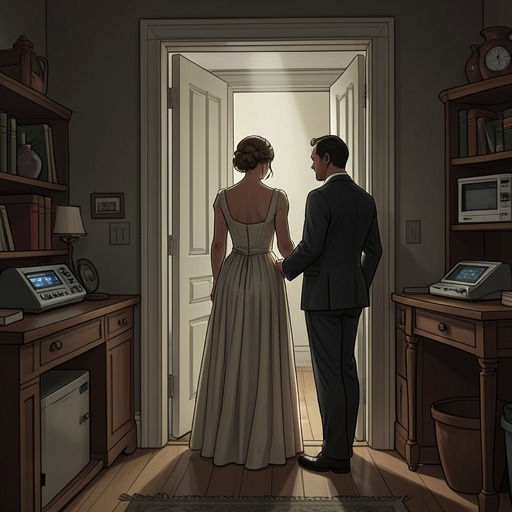
The maidservant opened the door before Hemingway rang and told him to come in: Stein would be down at any moment. Though it was before noon, she poured him a glass of eau-de-vie and winked happily. As the alcohol was still in his mouth, Hemingway heard someone speaking to Stein in a way he had never heard one person speak to another. Then Stein’s voice reached him, pleading: “Don’t, pussy. Don’t. Don’t, please don’t. I’ll do anything, pussy, but please don’t do it. Please don’t. Please don’t, pussy.” The passage does not explain who is being addressed or what is happening. Instead, it marks the limits of what Hemingway can bear to hear: he swallows the drink, puts down the glass, and starts for the door.
The maidservant shakes a finger at him and whispers that he should stay because Stein will be down soon. Hemingway answers, “I have to go,” and tries not to hear more. He says the replies are worse than the pleading, and that the only way not to hear it is to be gone. In the courtyard, he asks the maidservant to say that he came out and met her, that he could not wait because a friend was sick, and to wish Stein bon voyage for him. He promises to write. The excuse allows him to leave without confronting Stein, but it also makes the departure itself part of the rupture: he does not say goodbye to her face to face.
An ending without a formal break
Hemingway calls the way the friendship finished “stupidly enough.” The word resists the shape of a decisive, openly discussed break. For a time, he still did small jobs, made necessary appearances, brought people Stein had asked for, and waited with the other male friends to be dismissed when a new circle moved in. The scene at the house thus marks a change in his ability to be close to Stein, while the social connection and its obligations continue afterward.
That later change has its own visible signs. New friends replace the old ones, and Hemingway is saddened to see new, worthless pictures hung among the great pictures. Stein quarrels with nearly all the people fond of her, except Juan Gris, who is dead; eventually, she quarrels with the new friends too. Hemingway’s account does not make the quarrels themselves the cause of his private estrangement. Rather, they belong to a larger pattern of changing company and diminishing attachment. He says he and the others eventually made friends with Stein again so as not to be stuffy or righteous. He did so outwardly, but not truly.
The irrecoverable inward distance
The distinction between renewed acquaintance and recovered friendship gives the episode its lasting consequence. Hemingway can return to the social arrangement, perform favors, and appear among Stein’s circle, yet cannot make the friendship again “in my heart nor in my head.” The repeated emphasis on the head makes the loss more than hurt feeling: even his understanding and memory of the relationship have changed. He calls this inability the worst part, then adds that the matter was more complicated than that, refusing a simple explanation or a tidy reconciliation.
The passage’s form reinforces that refusal. A remembered spring morning is rendered through small, concrete actions—the glass swallowed, the maidservant’s warning finger, the fabricated excuse in the courtyard—while the central circumstance remains unexplained. The reader is given the sound that precipitates Hemingway’s departure but not an account of its cause. Against the earlier generosity of Stein’s open invitation, his exit is quiet and indirect; against the later return to friendliness, the emotional break persists. The ending is therefore neither a public feud nor a complete disappearance. It is the narrower, more durable separation Hemingway describes: he can resume the gestures of friendship, but cannot make himself a friend again.